
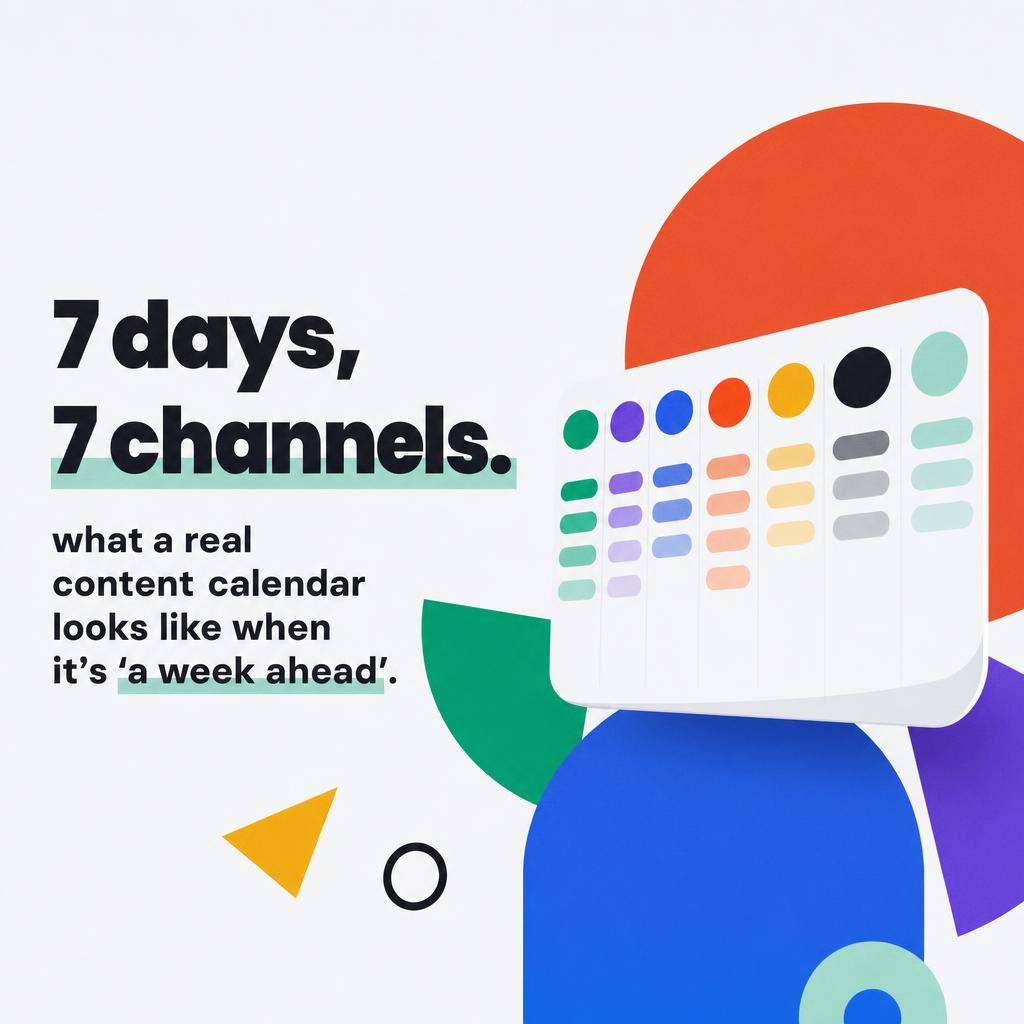
7 Days, 7 Channels: What a Real Content Calendar Actually Looks Like
A day-by-day breakdown of what being 'a week ahead' on content really means — one idea, translated across seven channels, without the Sunday-night panic.
Everyone says they want to be "a week ahead" on content. It's the content-marketing equivalent of saying you'll start going to the gym on Monday — a nice idea that quietly dies somewhere around Wednesday, when a client fire needs putting out and the blank calendar is still blank.
The problem isn't motivation. It's that nobody actually shows you what "a week ahead" looks like in practice. It's not a vague vibe of feeling organised. It's a real, specific, seven-day, seven-channel plan, sitting there ready to go, that you didn't have to bleed for.
So let's actually build one — day by day, channel by channel, the way it would look if you opened your calendar on a Sunday night and saw the whole week smiling back at you, done.
Why "a week ahead" is the whole game
Most content strategies fail for one boring reason: they're built one post at a time, under pressure, right before posting. That's not a strategy, that's triage. When you're deciding what to post today, you're never thinking about your brand, your audience, or your goals — you're thinking about how fast you can fill the gap before your feed goes quiet.
Being a week ahead flips that completely. Every decision gets made once, calmly, in a single sitting — not seven separate times, in seven separate panics, spread across seven separate days. It means when a customer lands on your Instagram on a random Tuesday, there's something fresh there, not a post from three weeks ago and an apologetic caption about "getting back into it."
More than anything, it means consistency — the unsexy, unglamorous ingredient that actually makes content work. Algorithms reward it. Audiences trust it. And your future self, the one who used to dread Sunday nights, gets to relax instead.
Day 1–2: The written backbone — blog and LinkedIn
A real content calendar starts with the channels that carry the most weight and take the longest to think through: your blog and LinkedIn. These aren't throwaway posts — they're where you explain, teach, and build authority.
A long-form SEO blog article, something in the 1,500-word range, is your anchor for the week. It's the piece that ranks on Google, gets shared, and gives every other channel something to point back to.
LinkedIn, meanwhile, is where you show up as a human with opinions, not just a company with a blog. A good week-ahead calendar has a LinkedIn post that takes an idea from that blog article and reframes it — shorter, punchier, more personal, maybe a little more provocative. Same insight, completely different outfit. This is where people get "repurposing" wrong: they just paste the same words into a new box. A real calendar treats every channel like it has its own personality.
By the time Monday and Tuesday's content is locked, you've already done the hardest thinking of the week — the actual idea generation. Everything after this is translation, not invention.
Day 3: Instagram — the visual translation
Wednesday's job is Instagram, and Instagram doesn't want your blog post. It wants a caption that feels like a conversation, paired with a visual hook that stops the scroll in half a second.
This is where that Monday idea gets stripped down to its emotional core — the one line that makes someone go "oh, that's exactly my problem" — and gets paired with a carousel, a quote graphic, or a simple photo.
The trap here is trying to write Instagram captions the same way you write LinkedIn posts, just shorter. It doesn't work, because the audience behaviour is completely different. People aren't scrolling Instagram to read a think-piece; they're scrolling for something quick, visual, and a little bit personality-driven.
Getting this right consistently, week after week, is honestly where most solo founders and small teams burn out — it requires context-switching seven different ways, in one sitting, without losing your actual voice.
Day 4: Twitter/X — the sharp one-liner
Thursday belongs to the platform that punishes anything soft or vague: Twitter/X. Here, the same core idea from earlier in the week needs to be boiled down even further — one sharp sentence, maybe a thread if there's real substance, but never padding. If your blog post made an argument in 1,500 words, your tweet needs to make it in fifteen.
This is also the channel where brand voice gets tested the hardest. Corporate, safe language just doesn't survive on Twitter — it gets scrolled past instantly. A real content calendar doesn't try to sanitise your opinions for this channel; it sharpens them.
Because it's already planned as part of the week, you're not staring at the compose box wondering what to say. The idea already exists. You're just finding its sharpest, punchiest shape.
Day 5: TikTok or Reels — the hook-first channel
Friday is video day, and video day is where a lot of "week ahead" plans quietly fall apart, because video feels like a different beast entirely. But it doesn't have to be. The same core idea that started the week as a blog post can become a fifteen-second hook: a bold opening line, a quick payoff, maybe a text overlay that repeats the punchline.
What makes this genuinely achievable — instead of another task you keep pushing to "next week" — is writing the hook and caption in advance, as part of the same planning session as everything else. You're translating an idea you already validated four days earlier into the native language of short-form video.
TikTok has a reputation for demanding a totally different, ultra-casual tone, but the brands that do it well are still recognisably themselves — just louder and quicker. Losing your voice for the sake of "fitting the platform" is how brands end up with content that gets views but builds zero trust.
Day 6–7: The Medium essay and the wildcard
The weekend, or the tail end of your week, is where the long-form story-led piece lives — something like a Medium essay. This is different from the SEO blog article: less "here's how to solve your problem" and more "here's what we believe, and why." It builds emotional connection rather than search traffic, and it's often shared by people who don't even need your product yet but respect how you think.
The final slot — your seventh channel — is the wildcard: an email newsletter blurb, a Pinterest pin, a YouTube community post, whatever fits your actual audience. A real week-ahead calendar isn't a rigid template forced onto every business; it's seven genuine touchpoints, chosen because your audience actually shows up there.
By day seven, you've taken a single idea and let it live seven different lives — each dressed appropriately for where it's going, each still unmistakably, recognisably you.
Where most people get stuck (and the shortcut that actually works)
Here's the honest bit: everything above is completely doable by hand. Plenty of brilliant marketers do exactly this every single week, with a spreadsheet and a strong coffee. But it takes hours — writing the idea, then translating it seven times, into seven different tones, for seven different audiences, while somehow keeping the brand voice consistent throughout. That's not a Sunday-night task; that's a part-time job.
That's the actual gap shrthnd was built to close. You give it your website — your homepage, your blog, wherever you've already explained what you do and how you sound — and it reads it the way a very attentive new hire would: learning your tone, your phrasing, the jargon you use and the jargon you'd never touch. Then it writes ready-to-post drafts for every channel, natively, so your LinkedIn post doesn't read like a shrunk-down blog and your TikTok hook doesn't read like a corporate memo wearing a baseball cap.
Instead of staring at seven blank boxes every week, you open a calendar that's already a week ahead — 30 days of it, in fact, always rolling forward, always in your voice, for about the price most freelancers charge for a single post. No brief. No blank page. Just the translation work, already done.
Your move
Being "a week ahead" isn't a personality trait some founders are lucky enough to have — it's just a system, and now you've seen exactly what that system looks like: one strong idea, translated seven honest ways, across the channels your audience actually uses.
You can build that system by hand, one caffeinated Sunday at a time, or you can let shrthnd read your site and hand you the whole week, done and dusted, in your own voice.
Either way, the blank calendar doesn't have to be the enemy anymore. Start your free 7-day trial at shrthnd.ai — no card needed — and see what a real week ahead actually feels like.
Frequently asked
What does it actually mean to be "a week ahead" on content?
It means every content decision for the week — across all channels — is made once, calmly, in a single sitting, rather than being decided under pressure each day right before posting.
Do I need to write completely different content for each channel?
Yes. A real week-ahead calendar takes one core idea and translates it into the native tone and format of each platform — a blog post, a LinkedIn reframe, an Instagram caption, a sharp tweet, a video hook, an essay, and a wildcard touchpoint — rather than pasting the same text everywhere.
Why do most content calendars fail?
Because they're built reactively, one post at a time, under pressure, which turns content into triage rather than strategy. Consistency, not motivation, is what actually makes content work.
How does shrthnd help with this process?
shrthnd reads your website to learn your tone and phrasing, then generates ready-to-post drafts for every channel natively — so each post fits its platform without losing your brand voice, saving the hours it would take to translate one idea across seven channels by hand.